Swimming in Lake Annecy: Water Temperature, Spots and Open-Water Rules
Water temperature month by month, where to swim open water, the thermocline, wetsuits and the lake crossing: swimming in Annecy, taken seriously.
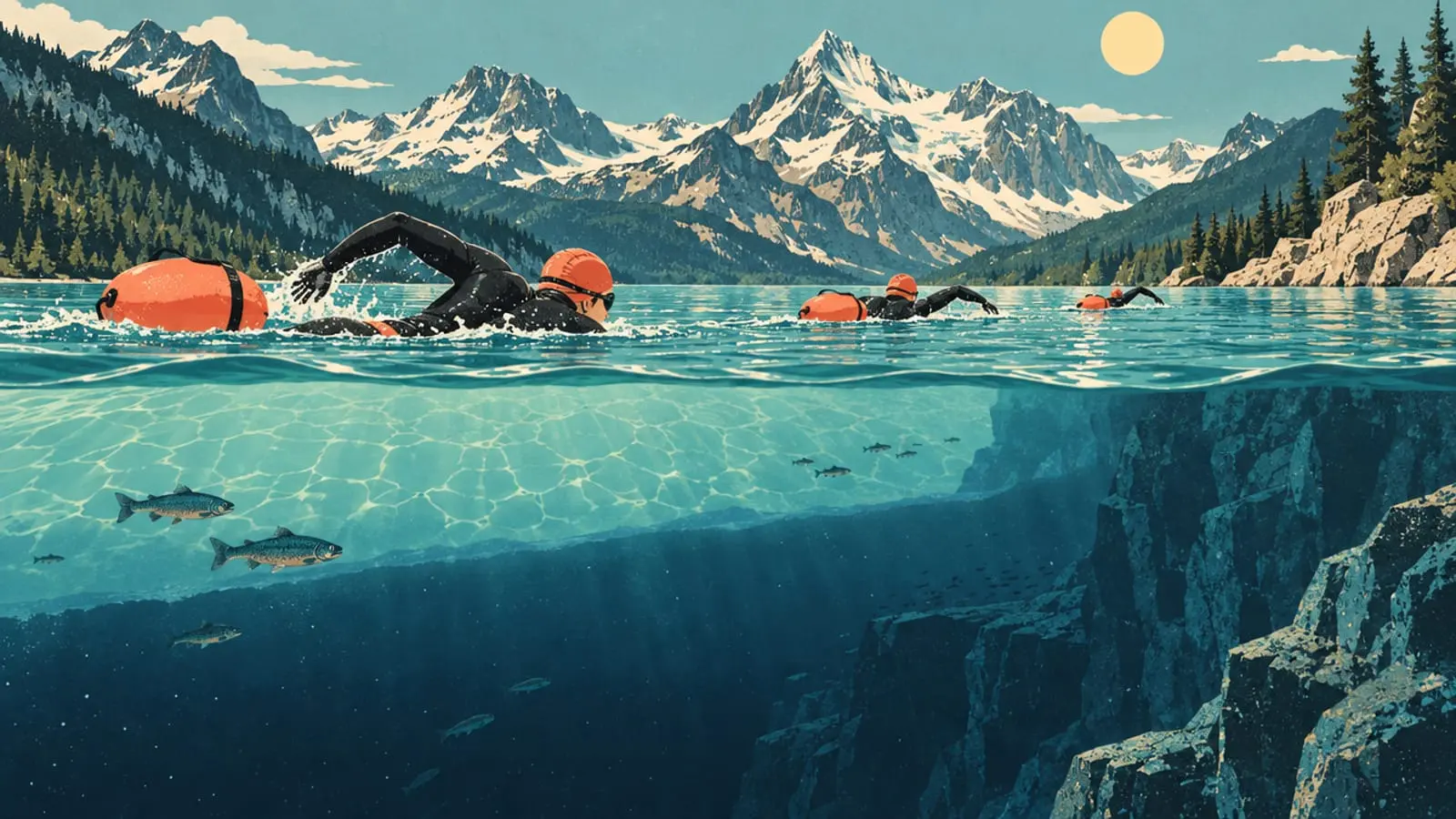
There are two ways into this lake: bathing — ten metres, a plunge, a towel — and swimming. The second has its codes, its season, its kit, and an exceptional playground: water among the clearest in Europe, legible shores, and a legendary event that crosses the lake every summer. Here is open water in Annecy, taken seriously.
The temperature, month by month — and at depth
The surface trails the summer: cool in June, 22-24 °C at the height of summer, still kind in early September — the lake runs weeks behind the air — the month-by-month detail is in our piece on the water temperature. That’s why the late-September triathlon is still swimmable, and why June always disappoints the impatient.
But the number that matters to the open-water swimmer is elsewhere: below about fifteen metres, the water stays between 6 and 8 °C all year. Moving offshore, you swim above a cold reservoir — and the thermocline can be crossed just a few metres down. A crawl offshore is not an extended bathe: it’s another discipline.
Where to actually swim
- Along the shores, early in the morning. Before the boats and the wind, the water is a mirror: this is the local swimmers’ slot. The beaches serve as entry and exit points.
- The marked bathing zones for easy sessions: the lake is busy with boats, and the yellow buoys are not decorative.
- The bay at the far end for the warmest water — depth explains everything: shallow, it warms fast and cools late.
Golden rule outside marked zones: a visible swim buoy (the orange float tied at the waist). It doesn’t carry you; it makes you visible to boats — the most important piece of kit after the suit.
The lake crossing: the fixture
Every summer, in mid-August, hundreds of swimmers set off on the lake swim crossing — Annecy’s great popular open-water event, backed by the tourist office and relayed in our calendar each year. It’s the perfect goal for a summer of training: within reach of a regular swimmer, unforgettable at first light.
The wetsuit, without dogma
- July-August: optional for most, over sensible distances.
- June and September-October: recommended beyond a quarter of an hour — the body cools faster than a swimmer feels it.
- The rest of the year: thick-neoprene territory, for seasoned swimmers. The lake almost never freezes, but 8 °C doesn’t need ice to be serious.
What we wouldn’t do
- Cross the lake outside the organised event. Two kilometres of navigable water, alone and invisible: no. The crossing exists for that.
- Swim offshore without a visibility buoy. Boats do not see you — being visible is your job.
- Trust the first few minutes’ sensation. Water that feels “fine” on entry chills a resting body fast; at the first shiver, get out.
- Dive offshore after a heatwave without acclimatising. The thermocline’s thermal shock surprises even the regulars.
The lake rewards swimmers the way it rewards early risers: with an hour when it belongs entirely to them. A crawl at 7.30 a.m. in 22-degree water, the mist lifting, the Semnoz in silhouette — it’s the finest swimming pool in the Alps, and it’s free.
Frequently asked questions
- What is the water temperature of Lake Annecy?
- At the surface: around 22-24 °C at the height of summer, still kind in early September, cold in spring. At depth, below about fifteen metres, the water stays between 6 and 8 °C all year.
- Can you swim open water in Lake Annecy?
- Yes — it's one of the great open-water playgrounds of the Alps, with an organised lake crossing every summer. Swim along the shores, inside the marked bathing zones, or with a visible swim buoy.
- Do you need a wetsuit to swim in Lake Annecy?
- Outside July-September, yes for most swimmers. Even in summer, the chill surprises as soon as you leave the shore: the thermocline sits a few metres below the surface.
Sources
Read next
Around Lake Annecy →
How was Lake Annecy born? The story as a comic strip
Twenty thousand years ago, the valley lay under ice. Nine drawn panels to understand, with Lou and Malo, how Lake Annecy came to be.
The lake that nearly choked: the story as a comic strip
In the 1950s, Lake Annecy was turning murky. Nine panels to understand, with Lou and Malo, how it was saved and why its water is so clear today.