Lake Annecy water temperature: what happens, month by month
Over 25 °C at the surface in summer 2023, around 7 °C through the whole lake in winter: Lake Annecy’s water temperature month by month, backed by measurements.
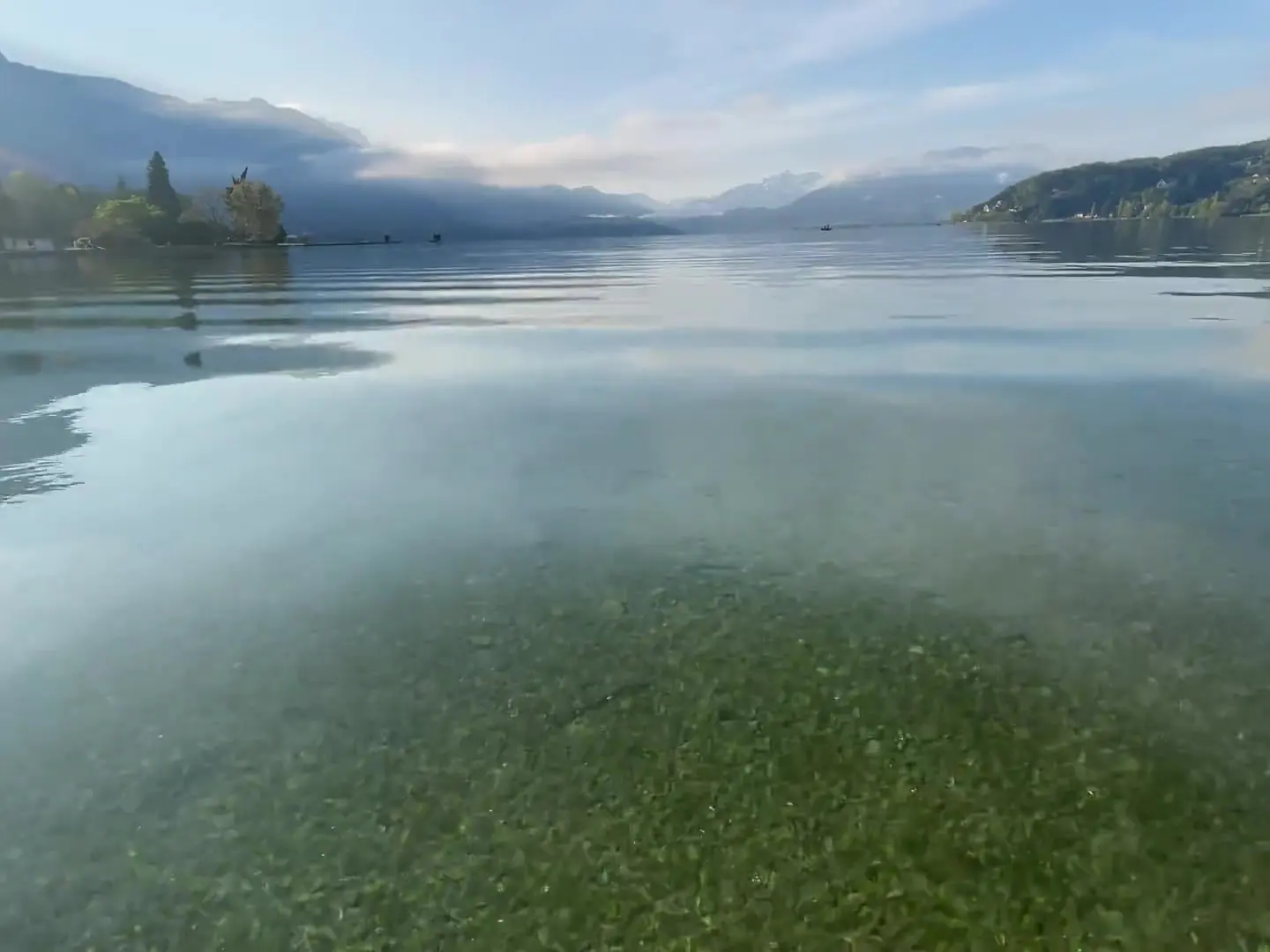
“How warm is the water?” It is the question everyone asks at the lakeside, and the answer changes far more than you would think — with the month, of course, but also with depth. Here is what the measurements say, month by month, without the round numbers that circulate everywhere.
The short answer
- At the height of summer: the surface sits around 22 to 24 °C, and it went above 25 °C in 2023, according to the scientific monitoring by SILA (the lake’s management body) and INRAE (the French national research institute for agriculture and environment).
- Late September: on 22 September 2026, the tourist office still showed 21.4 °C at the surface.
- In winter: the whole lake mixes and reaches roughly the same temperature — 7.15 °C on average through the entire water column in 2023.
- At depth: below about fifteen metres, the water stays cold all year, between 6 and 8 °C.
An honest note: there is no official month-by-month table of surface temperature. SILA and INRAE publish curves and summaries; the numeric tables found online generally have no published method. Below, every figure comes from an official measurement; where there is none, we describe what happens.
Month by month
| Period | Surface | In the lake |
|---|---|---|
| January – February | ≈ 7 °C (whole lake, 2023) | Full mixing |
| March – April | Warming | Thermocline sets in |
| May – June | Still cool | Mild surface, cold depths |
| July – August | 22-24 °C, > 25 °C in 2023 | Thermocline near 15 m |
| September | 21.4 °C on 22/09/2026 | Lake gives back summer |
| October | Dropping clearly | Thermocline near 20 m |
| November – December | Cold | Layering fades |
What the table means:
- In winter, the chilled surface sinks and deep water rises: the whole lake mixes. In 2023, that full mixing came at the end of February.
- From April, the surface separates from the deep layers: a thermal boundary, the thermocline, sets in and stays until autumn.
- In June, the surface warms in the sun, but the water stays colder than the air suggests.
- In July and August, it peaks: above the thermocline, around 15 m, swimming water; below it, permanent cold.
- In September, the lake has stored the summer and releases it slowly.
- In October, the thermocline sinks — to around 20 m in 2024 — as the surface cools.
- In November and December, the layering fades (in November in 2023, in December in 2024) before the great winter mixing.
Why the water is cold in June and pleasant in September
The lake lives weeks behind the air. In spring, the cold winter water must warm up first; in September, all the summer’s heat is still there. Hence the paradox regulars know well: a late-summer swim is often more pleasant than a June one, for cooler air. Our piece on how the lake fills and warms explains the mechanics.
What the thermocline means for swimmers
In summer the heat stays at the top. Around 15 m, the temperature drops sharply: that is the thermocline. For a swimmer, nothing changes — you stay in the warm surface water. For a diver or a freediver going down, it is a wall of cold. And for everyone, it is a reason for care: falling in far from shore out of season means water that is nothing like summer. Our guide to open-water swimming covers the precautions, and the lake’s depth shows where it drops away fast.
A lake that is warming
SILA and INRAE measure a clear trend:
- +1 °C at the surface (0 to 5 m) since 1980.
- A water column 2 °C warmer in 2024 than in 1966-1980.
- In winter: the whole-lake average rose from 5.7 °C around 2010 to 7.15 °C in 2023.
The simulations in SILA and INRAE’s foresight study project +2.1 °C at the surface by 2100 in the scenario they consider likely. The lake will keep mixing every winter — and that mixing is what re-oxygenates the depths, so the trend is closely watched. To understand why the lake stays so clear regardless, read why the water is clear.
When to swim, in practice
- The comfortable season: July to early September.
- Annecy’s lifeguarded beaches (Albigny, Impérial, Marquisats) are supervised from 4 July to 31 August 2026. Outside those dates, you swim at your own risk.
- The best time: late afternoon, once the surface has warmed all day. Our lake beaches and five swim spots by bike give the addresses.
- Before you go: the tourist office publishes a live temperature reading.
What we wouldn’t do
- Trust a table of “monthly averages” with no source. The ones that circulate often claim 4 °C in January, when official measurements found around 7 °C through the whole lake in winter 2023.
- Freedive below the thermocline without a wetsuit, trusting the beach temperature.
- Expect a frozen lake in January. With 7 °C through the whole body of water, it almost never freezes.
A swim is planned around the day’s weather as much as the month. Our Annecy-specialised AI concierge puts the beach at the right moment of your days, with a plan B when the sky won’t play along. Day 1 is free →
Frequently asked questions
- How warm is Lake Annecy in summer?
- At the height of summer the surface sits around 22 to 24 °C, and it went above 25 °C in 2023 according to the scientific monitoring by SILA and INRAE. Below about fifteen metres, the water stays cold all year.
- When can you swim in Lake Annecy?
- The comfortable season runs from July to early September. Annecy’s lifeguarded beaches (Albigny, Impérial, Marquisats) are supervised from 4 July to 31 August in 2026. On 22 September 2026 the tourist office still showed 21.4 °C at the surface.
- How cold is Lake Annecy in winter?
- In winter the lake mixes completely and the whole water column reaches roughly the same temperature: 7.15 °C on average in 2023, against 5.7 °C around 2010, according to SILA and INRAE.
Sources
- Ecological quality monitoring of Lake Annecy, 2023 report — SILA and INRAE (PDF, French)
- Ecological quality monitoring of Lake Annecy, 2024 report — SILA and INRAE (PDF, French)
- Climate change foresight study for Lake Annecy — SILA and INRAE (PDF, French)
- Lake Annecy water temperature — Lake Annecy Tourist Office (French)
- Beaches and lifeguard supervision — Ville d’Annecy (French)
Read next
Around Lake Annecy →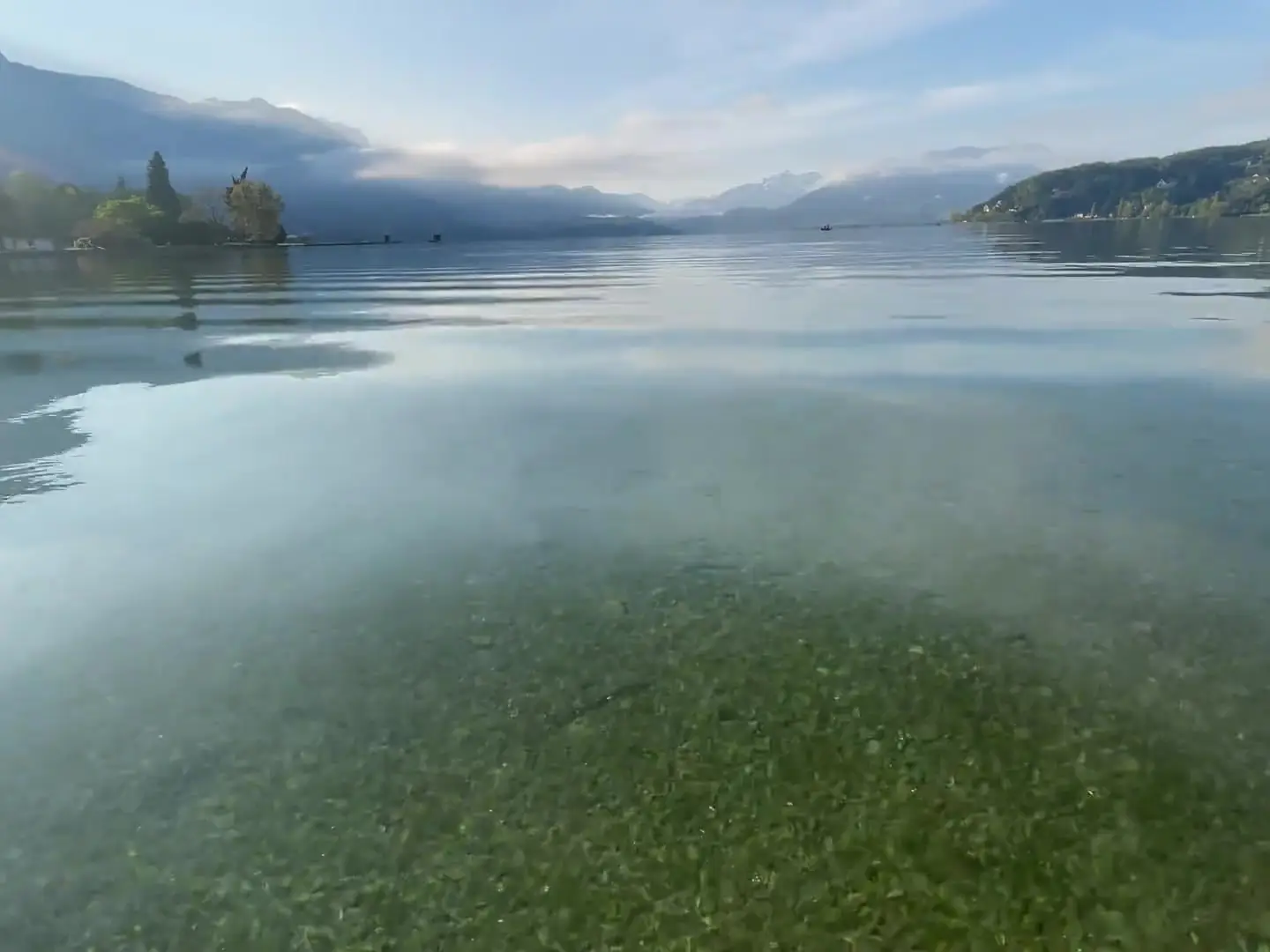
Swimming in Lake Annecy: Water Temperature, Spots and Open-Water Rules
Water temperature month by month, where to swim open water, the thermocline, wetsuits and the lake crossing: swimming in Annecy, taken seriously.
The Angon Waterfall: The Cliff-Cut Path Above Talloires
Above Talloires, a handrail-equipped path cut into the cliff passes behind the Angon waterfall. Access, the real difficulty, footwear — and what to avoid.