Why Lake Annecy's water is so clear
The lake nearly suffocated in the 1950s. What saved it was a sewer collector laid right around its shores between 1961 and 1976.
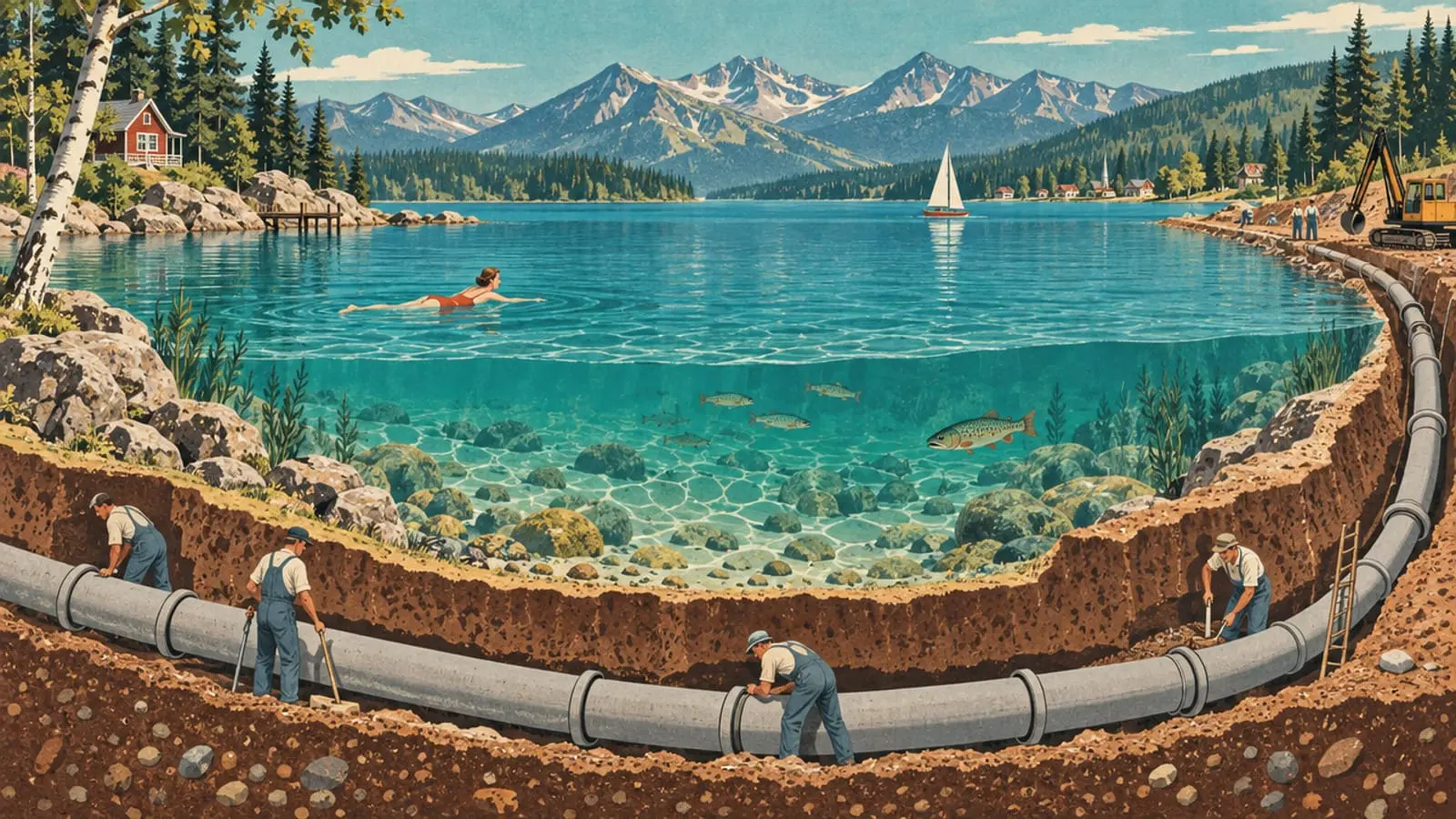
You will be told the water is clear because the lake is alpine. That is wrong, or at least badly incomplete: seventy years ago this alpine lake smelled bad in summer and was losing the fish that live near its bed. The transparency you are looking at from the beach is not a gift of geography. It is a piece of civil engineering, decided in 1957 and paid for over fifteen years.
What the lake was turning into
The technical word is eutrophication, and the mechanism is blunt. Waste water from the shoreline went straight into the lake, loaded with phosphorus — from households first, then from detergents as they spread through the 1950s. Phosphorus is fertiliser. Microscopic algae feed on it and multiply. When they die they sink, and their decomposition eats the oxygen near the bottom.
From there the loop closes on itself. A deoxygenated lakebed releases the phosphorus stored in its sediments, which feeds the next bloom. Deep-water species, the ones that need a cold, well-oxygenated bottom, are the first to go. The symptoms were visible from the 1940s at Annecy as at Lake Bourget, and they worsened after the war as building along the shore accelerated.
One figure gives the scale. In the late 1950s, transparency measured with a Secchi disc was down to a few metres. Today it runs into the tens of metres in spring.
15 July 1957: eight communes sign
The alarm came from local science and medicine — Professor Hubault, Dr Paul-Louis Servettaz — and found a political relay in Charles Bosson, then mayor of Annecy. On 15 July 1957, eight lakeside communes created the SILA, the intercommunal syndicate of Lake Annecy.
That starting point is more interesting than it sounds. A lake is downstream of everybody. Each commune, taken on its own, had every incentive to discharge locally and hope the current would deal with it. What was needed was a body that made the decision collective. That institutional shift, not a technology, is what explains everything that follows.
The ring collector: a belt around the lake
The idea fits in a sentence: encircle the lake with a pipe that intercepts every discharge and takes it somewhere else. Construction ran from 1961 to 1976. The collector follows the shoreline, almost always under the road or the bank, falling by gravity towards the northern end.
The decisive choice was the destination. The water is not treated and returned to the lake: it is carried past the outlet, to a plant at Cran-Gevrier on the river Thiou. In other words, the town agreed to send its effluent down the river that fed it for six centuries — the same river that cut the millraces of the old town, a story we tell in why the old town has canals. The SILOÉ plant, commissioned in 1997, took over from the original station. Today the whole of the lake’s catchment is connected to mains drainage.
Why it worked here, and would not work everywhere
Four things were in Annecy’s favour, and they are worth knowing before treating this as a universal recipe.
| What the lake had going for it | Consequence |
|---|---|
| Mean depth of 41.5 m, 82 m at its deepest | A huge buffer volume for a small surface |
| A catchment of only 251 km² | Little intensive farming, no heavy industry upstream |
| A single outlet, in town: the Thiou | Everything that goes in leaves through one measurable point |
| Full renewal in roughly four years | The effect of a decision shows up within a decade |
That last line matters most. On a lake whose water takes forty years to renew, nobody would have lived to see the result of their own vote. Here, the generation that paid for the works watched the water come back.
What “the cleanest lake in Europe” actually means
The phrase is everywhere and corresponds to no official ranking. What does exist is measurement: continuous scientific monitoring since 1966, now run with INRAE, tracking transparency, phosphorus and nitrate concentrations, oxygen at depth, and temperature layer by layer.
Those readings say two things. First, the lake has returned to an oligotrophic state — poor in nutrients, which is the good outcome. Second, less comfortably, the file is not closed. Milder winters mix the water column less thoroughly — the same reason the lake barely freezes any more — and a lake that mixes badly renews the oxygen in its depths badly. The fight of the 1960s was about what people poured in. The fight of the coming decades is about climate, which no collector pipe can treat.
What we would not do
- Mistake clear water for empty water. The green weed you can see through the surface near the banks is not dirt. It is the vegetation of a healthy bed, and it is where fish spawn.
- Wash anything at the water’s edge. The collector intercepts pipework, not buckets.
- Assume this is permanent. The lake took twenty years to degrade and a generation to recover. Both directions remain available.
- Judge bathing water by eye. Clarity says nothing about bacteriology after a heavy storm — see instead our five swim spots you can reach by bike.
Next time you can pick out pebbles four metres down, remember you are looking at the outcome of an administrative deliberation held in 1957. Few landscapes are so openly political.
To read with children: the lake that nearly choked, as a comic strip.
Sources
Read next
Around Lake Annecy →
How was Lake Annecy born? The story as a comic strip
Twenty thousand years ago, the valley lay under ice. Nine drawn panels to understand, with Lou and Malo, how Lake Annecy came to be.
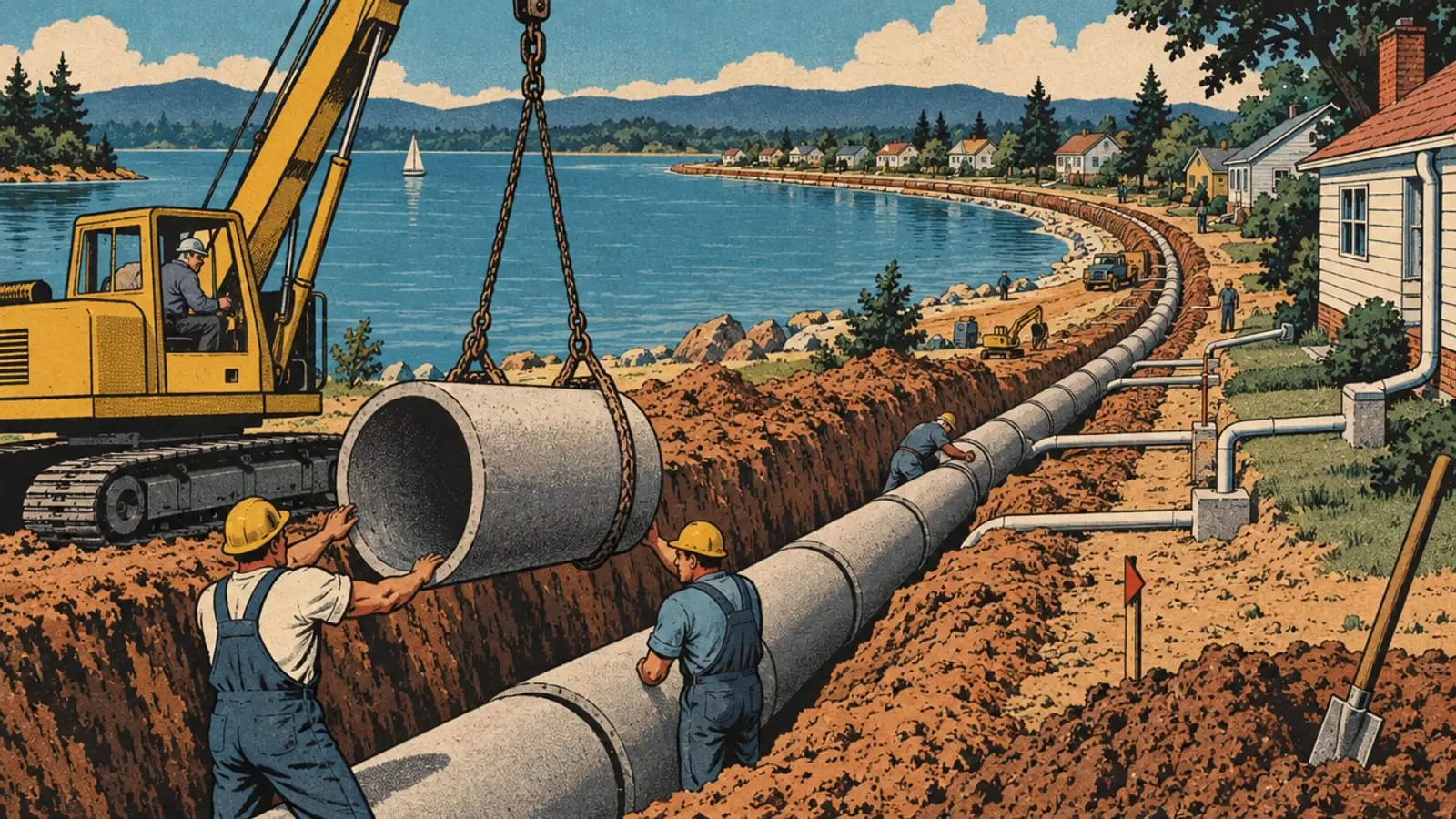
The lake that nearly choked: the story as a comic strip
In the 1950s, Lake Annecy was turning murky. Nine panels to understand, with Lou and Malo, how it was saved and why its water is so clear today.