Why the old town has canals (and no gondolas)
Annecy's canals aren't decorative. They are millraces cut to harness the Thiou, and six centuries of industry explain the old town.
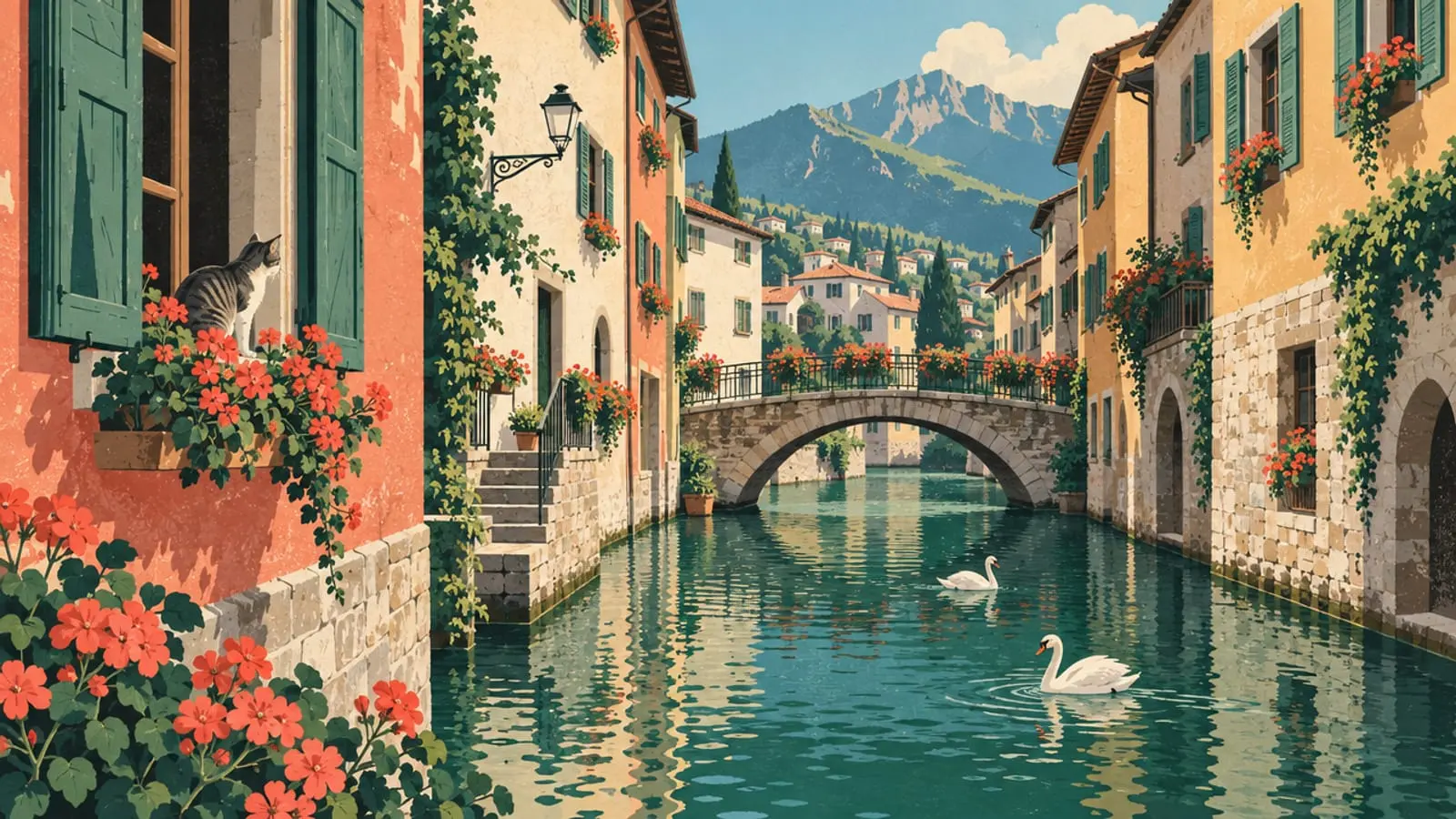
“The Venice of the Alps” is good tourist-board copy and a poor description. Venice grew out of a lagoon and seaborne trade; Annecy grew out of a very short, very powerful river. The canals everyone photographs today never carried gondolas. They are pieces of hydraulic engineering, and they explain the entire shape of the old town.
The Thiou: three and a half kilometres of motive power
The Thiou is the outlet of Lake Annecy. Water leaves the lake at its northern end, crosses the town and joins the Fier. It is one of the shortest rivers in France — roughly three and a half kilometres.
That shortness is not a curiosity. Over that distance the Thiou drops enough height to turn wheels, and its flow is regulated by a lake of twenty-seven square kilometres acting as an enormous buffer reservoir. In other words: abundant, steady water that neither freezes nor runs dry. For a town under the Ancien Régime, that is a power station before electricity.
Millraces, not ornamental canals
What people call the canals of Annecy are, for the most part, millraces: channels cut to bring water to a wheel and return it to the river downstream. The canal du Vassé, the canal du Thiou, the two arms that frame the Palais de l’Isle — all of them follow that logic.
Which is why the old town has such an odd geometry, with islets, arms that split and rejoin, and buildings sitting directly on the water. Those walls do not line the canal for effect: they are workshop walls, and the water ran underneath them.
What the water actually drove
For six centuries the town lived off that energy. Mills first, then tanneries — a foul-smelling trade with a huge appetite for water, pushed downstream — followed by spinning mills, paper mills, and from the nineteenth century a cotton works that made Annecy an industrial town long before it was a holiday town.
That detail changes how a walk reads. Going up the Thiou from the downstream end, the sluice gates, weirs and retaining walls you pass are not street furniture: they are the infrastructure. It was built to produce, and it stayed when the production left.
The Palais de l’Isle: neither a palace nor scenery
The most photographed building in the département — that stone prow planted mid-current — has a far less romantic history than its silhouette suggests. It occupies a natural islet in the Thiou and has served, depending on the period, as a residence, a mint, a courthouse, and a prison until the middle of the nineteenth century.
Its wedge shape is not an architect’s flourish: it is the cheapest answer to the problem of putting a building in a current that divides. The point splits the water, the two flanks follow the arms. Here, beauty is a by-product of hydraulics.
Why the town was built on this exact spot
Step back one notch. The counts of Geneva moved to Annecy in the thirteenth century, having lost their grip on Geneva itself. The town became the capital of a county, then, after the Genevan Reformation of the sixteenth century, an important Catholic fallback position — François de Sales installed the exiled bishopric of Geneva here.
Three advantages stacked up on this site: a natural bottleneck between the lake and the hills, a rock to put a castle on, and a river supplying water, energy and drainage at once. The canals are the methodical exploitation of the third.
What to look at as you walk
- The weirs and sluice gates, downstream of the Palais de l’Isle. They are what still sets the water level.
- The arcades of rue Sainte-Claire. They sheltered trade and merchants, not café terraces: the street was the market hall.
- The height of the door sills on the canal side. Several sit lower than the present quay — the town has been backfilled.
- The castle, on its spur. It is not watching the lake: it is watching the pass.
The Venice line will survive, because it works on a poster. But if you want to understand Annecy, forget the lagoon and follow the water the way it flows. It will tell you about a town that worked for a living long before it was photographed.
Sources
Read next
History & culture of Annecy →
The Annecy Festival: How the Town Became the World Capital of Animation
Since 1960, every June, Annecy hosts the world's biggest animated film festival. Its history, what it changes in town, and how to enjoy it without a badge.
Why Annecy Is Called the “Venice of the Alps” (and What the Nickname Misses)
Canals, flowered bridges, the Palais de l'Île: where the “Venice of the Alps” nickname comes from — and why the comparison misses the best part: millraces.