Why Annecy Is Called the “Venice of the Alps” (and What the Nickname Misses)
Canals, flowered bridges, the Palais de l'Île: where the “Venice of the Alps” nickname comes from — and why the comparison misses the best part: millraces.
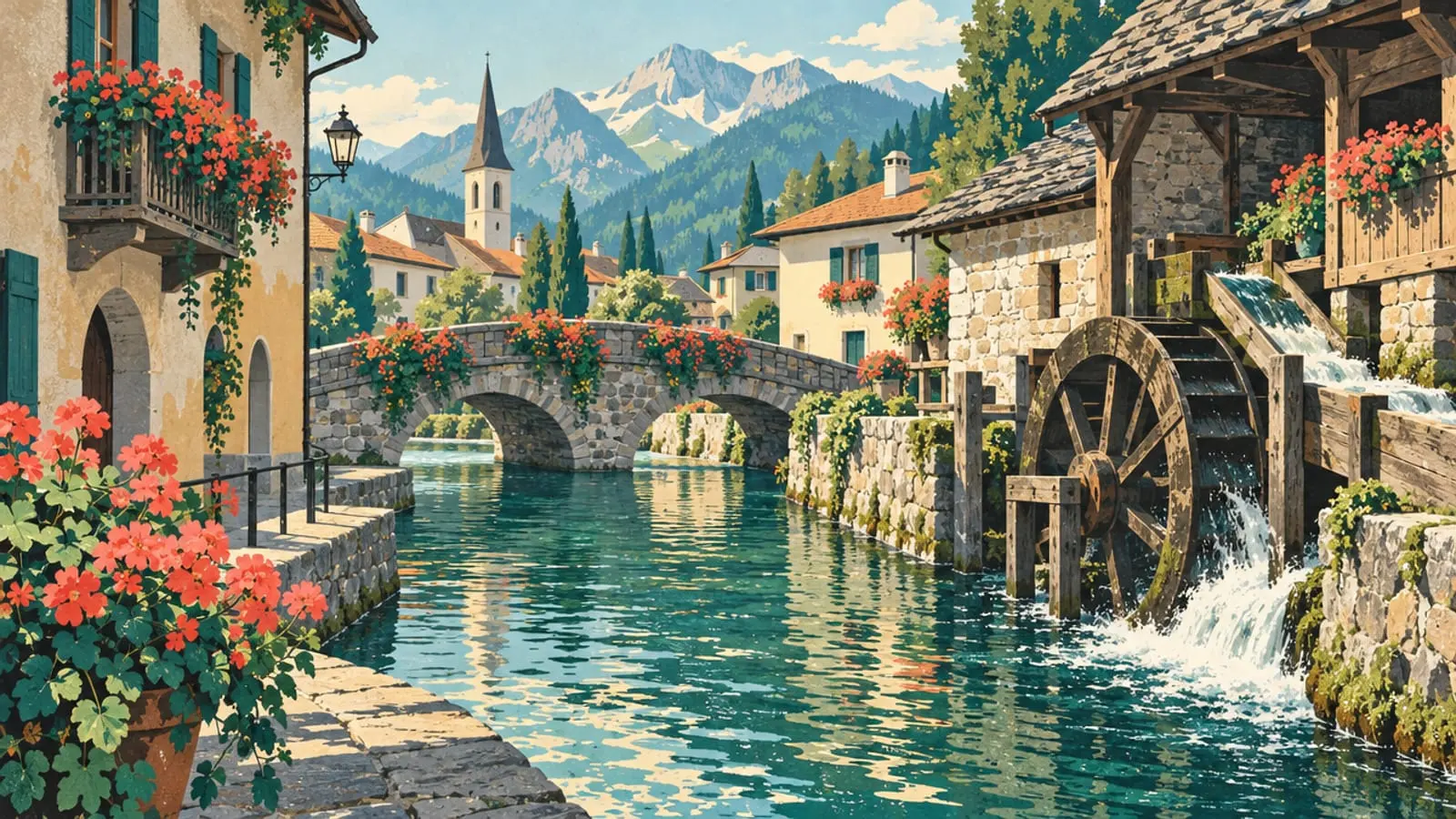
The nickname is on every brochure, and it does its job: “the Venice of the Alps” sells an old town of water, flowered bridges and pastel façades. The comparison isn’t stolen — but it misses precisely what makes Annecy singular. Venice is a city on water. Annecy is a city powered by water: its canals carried no gondolas, they drove machines.
Where the postcard comes from
The scenery is real enough: the Thiou — the lake’s outlet, one of the shortest rivers in France — branches through the old town, the Vassé canal slides beneath the Pont des Amours, and the Palais de l’Île splits the current like a stone prow. Add the arcades, the geraniums and the colour of the façades: the eye grasps the nickname in a second.
What the nickname misses: canals that worked
The difference is fundamental. In Venice, canals are streets. In Annecy, they are millraces: channels dug and calibrated to harness the driving power of the Thiou. For six centuries this water turned tanneries, spinning mills, grain mills and paper works — we’ve told that whole story here. The sluice gates you still see in town are not decorative: they regulate the level of the lake.
In other words: the “Venice of the Alps” was a hydraulic factory town. Less romantic on a brochure, far more interesting on the spot.
Where the comparison holds
One genuine common point: like Venice, Annecy is best on foot and early. The Thiou quays at 8 a.m., before the shops, with low light raking the water — that is the Venetian moment of the day, the hour of photographers and delivery bikes. At 3 p.m. in August it’s a corridor of crowds, as we wrote about the month of August.
And no gondolas here: the canals are narrow, shallow, unnavigable. The water you sail is the lake, from the quays — the exact inverse of Venice, where the lagoon is the backdrop and the canals are the way through.
What we wouldn’t do
- Look for the gondolas. They don’t exist; boating is on the lake.
- Stop at the Palais de l’Île photo. The building can be visited, and its prison history outdoes its façade.
- Reduce the old town to the nickname. The canals are the industrial skeleton of a former comital capital — the castle above tells the other half.
- Visit only at noon. Every water town is played at off-peak hours: early morning, or dusk.
Nicknames are shortcuts: this one brings visitors to the banks of the Thiou, and that’s already something. But the real local pride lies elsewhere — a town that put its water to work for six hundred years, then made it clean enough to photograph.
Frequently asked questions
- Why is Annecy nicknamed the Venice of the Alps?
- Because of its old town threaded with canals — the Thiou and the Vassé — lined with colourful façades and flowered bridges, evoking Venice in alpine format.
- Are Annecy's canals like Venice's?
- No, and that's the interesting part: they are millraces, channels dug to harness the Thiou's power and drive tanneries, mills and paper works. Venice navigates; Annecy worked.
- Can you take a boat trip on Annecy's canals?
- No — no gondolas here: the canals are narrow, shallow and unnavigable. Boating happens on the lake, departing from the nearby quays.
Sources
Read next
History & culture of Annecy →
The Annecy Festival: How the Town Became the World Capital of Animation
Since 1960, every June, Annecy hosts the world's biggest animated film festival. Its history, what it changes in town, and how to enjoy it without a badge.

The Château de Menthon-Saint-Bernard: A Thousand Years, One Family
Home to the Menthon family since the 11th century, built from the 12th to the 19th, open to visitors in summer: the castle overlooking Lake Annecy's east shore.