Annecy castle: why the counts of Geneva settled here
The counts of Geneva never ruled Geneva. They fell back on Annecy and built a castle on the spur that controls the crossing, and the town followed.
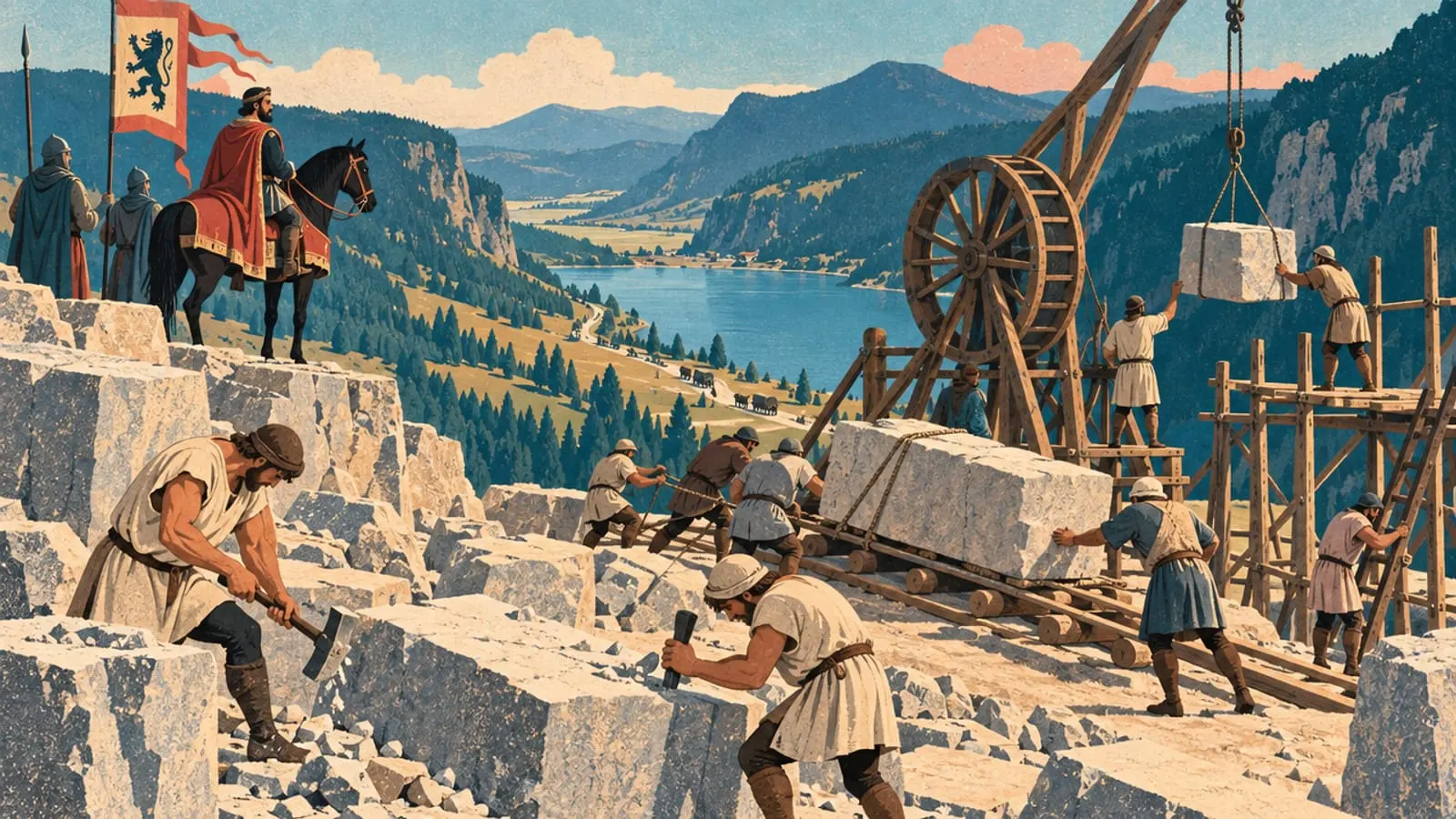
People climb to the castle for the view. It is the worst angle from which to understand it. The building was not placed on its rock to look at the lake. It was placed there because its owners had just lost a capital and needed another one. Everything else — the towers, the wings, six centuries of overlapping building sites — follows from that loss.
The counts of Geneva never held Geneva
That is the starting point, and it surprises everyone. The county of Geneva was a principality of the Holy Roman Empire, and the comital family produced seventeen counts, the first identifiable in the middle of the eleventh century. The city of Geneva itself, however, was never theirs: temporal power there belonged to the bishop.
The struggle was settled against them at the end of 1124, by the treaty of Seyssel. Count Aymon I recognised bishop Humbert de Grammont as the sole temporal lord of the city, kept only a castle at the Bourg-de-Four, and received rights and property elsewhere in the county in compensation. It was a trade of the town for the countryside. The quarrel would flare up for another century, but the outcome was fixed: the counts of Geneva were counts without their city.
A power with no capital has to manufacture one. That is the whole of what follows.
The county was a string of small districts, and Annecy sat in the middle
Look at what the county actually consisted of: the Semine, the Bornes plateau, the Thônes valleys, the Albanais, the Annecy basin. Geneva sits at the edge of that set. The Annecy basin is its geometric centre.
Then add the site. Between the foot of the Semnoz and the northern tip of the lake the ground narrows into a bottleneck, and the Thiou — the lake’s outflow — leaves at precisely that point. Whoever holds the rocky spur above the bottleneck holds the crossing, the outlet and whatever town forms below. The lower town, Annecy-le-Neuf, grew exactly there, at the foot of the rock, long before the present castle existed.
The counts were not picking a pretty landscape. They were picking a lock on what remained of their lands.
1219: the castle enters the written record
A fortification occupied the spur before it, but the castle as the archives begin to describe it appears in 1219. From then on things move quickly: the comital residence is fixed, the town spreads at the foot of the walls, and by the fourteenth century Annecy is the capital of the county of Geneva.
The stonework tells that trajectory better than any interpretation panel.
- The Tour de la Reine is the oldest part, twelfth century, with walls over four metres thick. That is defence and nothing else.
- A fire destroyed the whole thing in 1340. It was rebuilt to the same plan within the following four years.
- The Tour Perrière belongs to the fifteenth century, its building contract dated 1445. Still fortifying, but living better.
- The Logis Nemours in 1545, the Logis Neuf in 1562. By then it is over: nobody is adding towers any more, they are adding windows. The fortress has become a residence of prestige.
That sixteenth-century shift is not a matter of taste. It means the castle no longer had anything to defend.
1401: Annecy stops being the capital of a state
In 1394 Robert of Geneva died, the last count of the house — the same man who reigned as the antipope Clement VII. The title passed to the Thoire-Villars branch, which had neither the base nor the appetite for it. In 1401 Odon de Villars sold the county to Amadeus VIII of Savoy.
On that day Annecy changed category. It had been the seat of a principality; it became the chief town of an appanage inside a larger state, later held by the cadet branch of Genève-Nemours. The town kept growing, but it stopped deciding. That demotion is also what made its other destiny possible a century and a half later, when the bishopric of Geneva moved here in exile.
The long decline, then the museum
What comes next is less glorious and far more revealing. Burnt several times, the castle was abandoned in the seventeenth century. It was patched up to serve as barracks, a role it kept until 1947. Declared national property in 1793 and occupied by soldiers for the better part of two centuries, it ended up empty.
The town bought it in 1953 and restored it. Its listing as a monument historique dates from the decree of 12 October 1959, and covers the buildings, the enclosure and the courtyard ground inside it. The castle is now a municipal museum.
What we would not do
We would not climb up for the view alone, and certainly not last. Seen from the quays, the castle is scenery. Seen first, it is a key: the rest of the old town — the millraces, the islets, the walls standing in the current — then reads itself. We have written elsewhere about why those canals exist, and the two pieces answer each other.
We would also not go looking for a fairy-tale castle. What survives is a six-century building site, stitched together from alterations, with two centuries of barracks use having stripped out much of the interior decoration. That is exactly what makes it legible: function always beat ornament here, and the walls say so.
A castle is always read in the direction of the fear that built it. Here, the fear came from Geneva.
Sources
Read next
History & culture of Annecy →
The Annecy Festival: How the Town Became the World Capital of Animation
Since 1960, every June, Annecy hosts the world's biggest animated film festival. Its history, what it changes in town, and how to enjoy it without a badge.
Why Annecy Is Called the “Venice of the Alps” (and What the Nickname Misses)
Canals, flowered bridges, the Palais de l'Île: where the “Venice of the Alps” nickname comes from — and why the comparison misses the best part: millraces.