François de Sales and the exiled bishopric of Geneva
Driven out of Geneva by the Reformation, the bishopric fell back on Annecy. François de Sales ruled a cathedral he would never once enter.
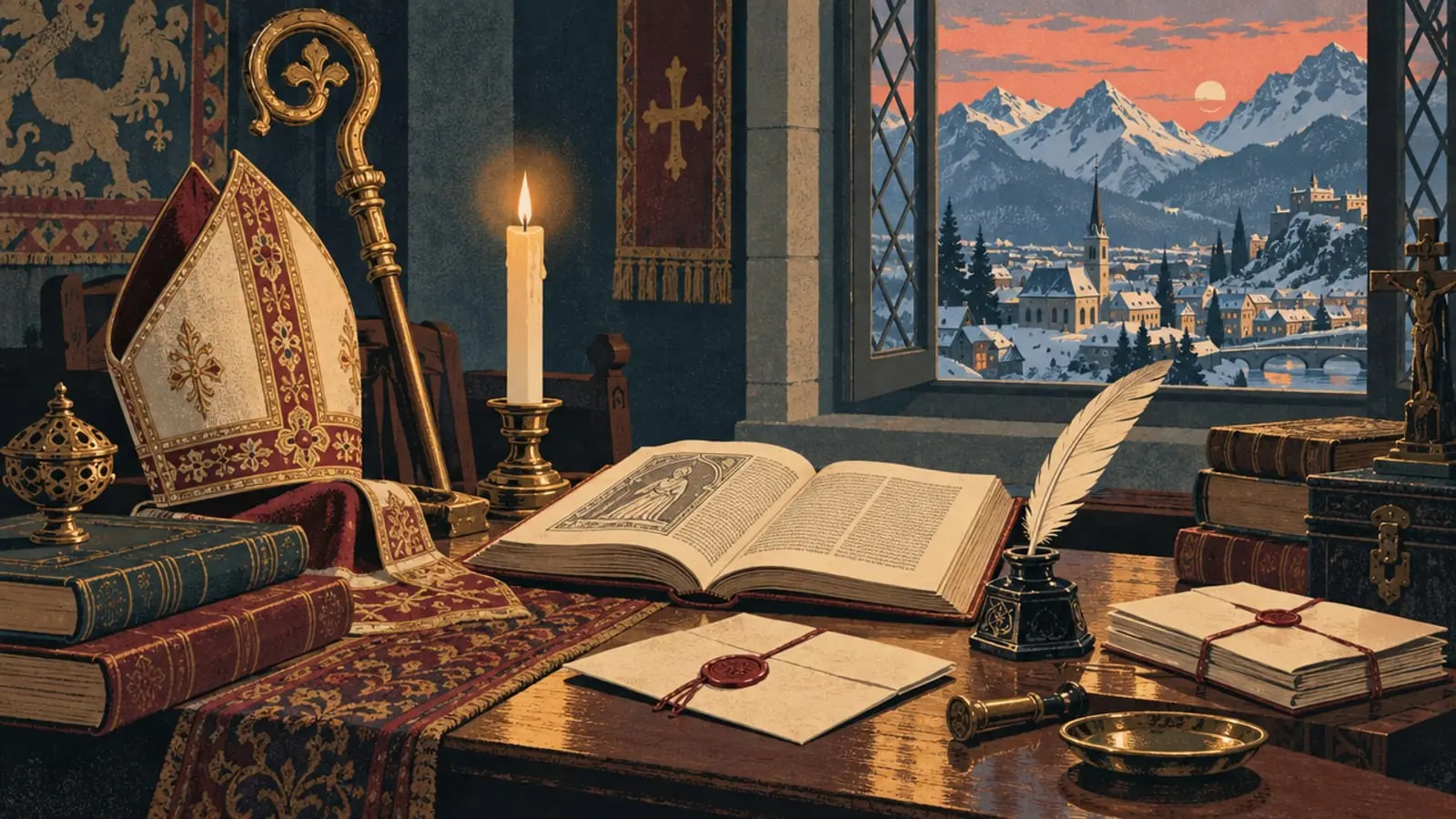
For close to three centuries the bishop of Geneva lived in Annecy. Not on visits: in residence, with his chapter, his archives and his title intact — bishop of a city he could not enter. That administrative anomaly did more to shape the old town than any planning scheme ever has.
1533 to 1568: a bishopric takes thirty-five years to move
The Reformation carried Geneva, and bishop Pierre de La Baume was driven out of the city in 1533. The see itself was not abolished; it was simply deprived of its city. The cathedral chapter of canons moved to Annecy in stages from 1535-36 and had fully withdrawn there by 1539 at the latest. The formal transfer of the episcopal seat came later, in 1568, under bishop Ange Justiniani.
The title, however, did not move at all. The holder remained “bishop of Geneva”, resident in Annecy, until 15 February 1822, when the bull Sollicita catholici gregis finally created the diocese of Annecy with Claude-François de Thiollaz as the first bishop to carry that name. Two hundred and eighty-nine years between the eviction and the change of label. Rome was in no hurry.
What a religious capital does to a small town
Annecy had already stopped being a political capital in 1401, when the county was sold to Savoy. A century and a half later it picked up a function of an entirely different kind, and a far more demanding one in physical terms.
A cathedral chapter means canons to house. A bishopric in exile means a seminary, archives, an administration. A frontier town of the Counter-Reformation means religious orders arriving and building, inside a defensive perimeter that does not grow to match.
Teaching followed the same logic. The collège chappuisien was founded in 1549 by Eustache Chappuis, a Savoyard who served as Charles V’s ambassador to Henry VIII. The stated purpose was to train minds capable of answering the arguments coming out of Geneva. The plot chosen sat in the middle of town, along the canal du Vassé, surrounded by convent foundations.
Hold on to that detail: in the sixteenth century, the property at the centre of Annecy is church property. That is a fact about urban form, not a footnote.
François de Sales: bishop of a city closed to him
Born on 21 August 1567 at the château de Sales, near Thorens, he began with the Chablais mission in 1594, preaching from the fortress of Allinges. Made coadjutor in 1599, he became bishop of Geneva in 1602 and was consecrated on 8 December that year at Thorens. He never once set foot in his cathedral.
What he did with an exiled see is more interesting than the title. He wrote: the preface to the Introduction to the Devout Life is signed in August 1608, and the book was printed at Lyon by Pierre Rigaud, then reprinted continually in his lifetime. The Treatise on the Love of God followed in 1616. On 6 June 1610, with Jane de Chantal, he founded the Visitation Sainte-Marie in Annecy.
He died at Lyon on 28 December 1622, and his body was brought back to Annecy in 1623. Beatified in 1661, canonised in 1665 by Alexander VII, he was proclaimed a doctor of the Church in 1877 by Pius IX and patron of journalists in 1923 by Pius XI. A town of a few thousand people at the end of an Alpine valley found itself, without seeking it, on a European map.
One building holds the whole story: Saint-François-de-Sales
Follow a single church and you get four centuries of Annecy.
Building starts in 1614, as the church of the first Visitation monastery. It then housed the tombs of the two founders, which made it a pilgrimage site. At the Revolution it was deconsecrated and used first as barracks, then as a canvas factory. It returned to worship in 1923, and the town acquired it in 1968.
Church, factory, church. The swerve into canvas is not an accident: it is precisely what happens to Annecy after 1793, when the town trades a religious economy for a hydraulic one. It is the same movement that filled the millraces with wheels and looms, described in our piece on the canals of the old town.
The bodies of the two saints, meanwhile, left the centre. A new monastery was begun in 1909 on the slopes of the Semnoz, and the relics were laid there on 2 August 1911. The adjoining basilica of the Visitation was built between 1922 and 1930 to designs by the Grenoble architect Alfred-Henri Recoura, and consecrated in 1949.
What we would not do
We would not read this as a religious story. It is one in part, but the interest lies elsewhere: this is the only period in which Annecy mattered on a continental scale, and it happened by accident — a city that had gone over to the Reformation less than forty kilometres to the north, and an episcopal see that refused to disappear with it.
Nor would we look for the traces of any of it on the quays. They are inside the blocks: in the size of the plots, in the closed courtyards, in the fact that the centre of an Alpine town is built tight around buildings nobody would put there today.
A town rarely remembers what it used to be. It keeps the shape, which is more reliable.
Sources
Read next
History & culture of Annecy →
The Annecy Festival: How the Town Became the World Capital of Animation
Since 1960, every June, Annecy hosts the world's biggest animated film festival. Its history, what it changes in town, and how to enjoy it without a badge.
Why Annecy Is Called the “Venice of the Alps” (and What the Nickname Misses)
Canals, flowered bridges, the Palais de l'Île: where the “Venice of the Alps” nickname comes from — and why the comparison misses the best part: millraces.