Does Lake Annecy Freeze? Not Fully Since 1891
Lake Annecy has not frozen over completely since the winter of 1891. Why a full freeze is so rare, what still ices up, and what a warming climate changes.
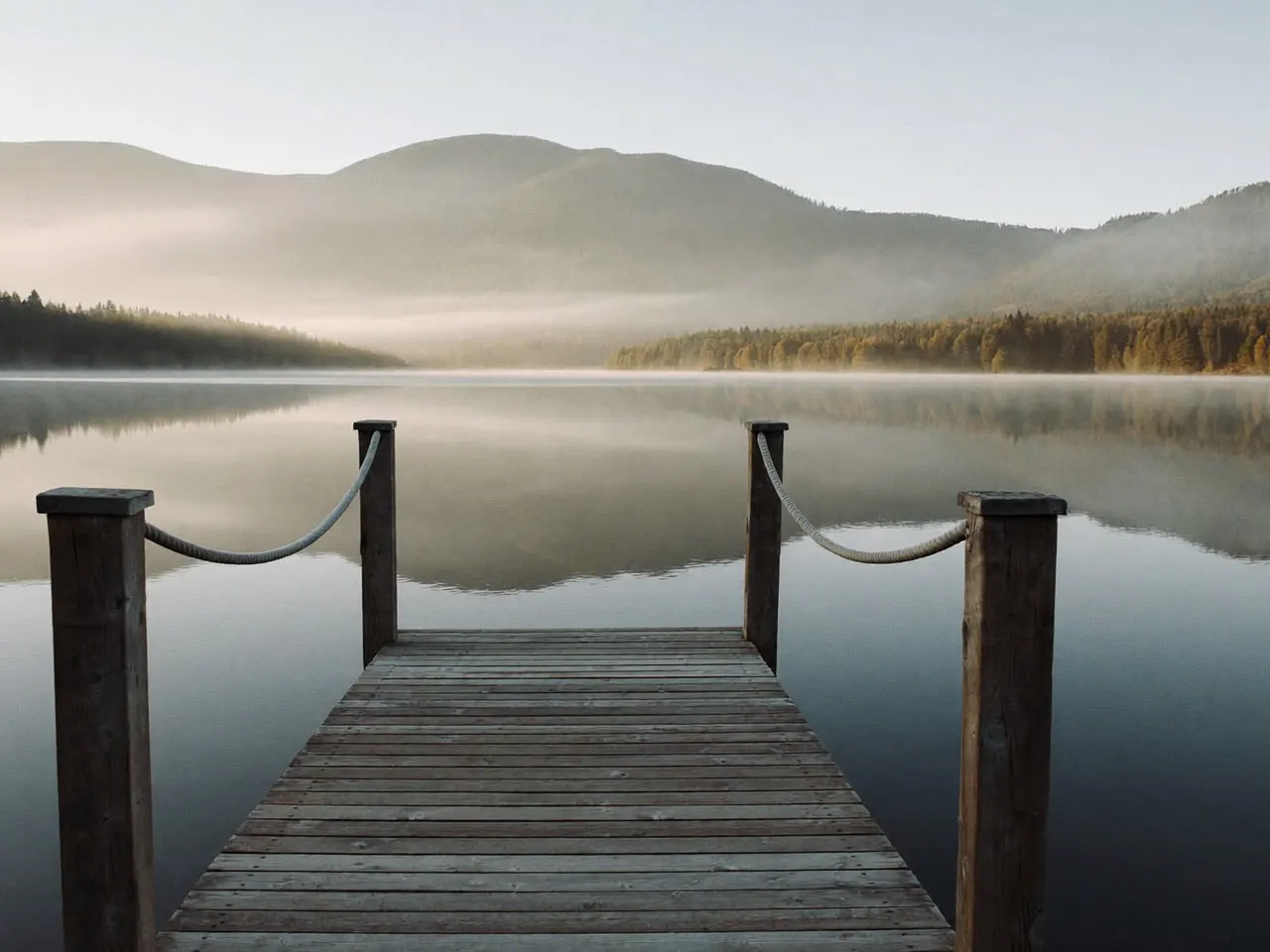
You picture skaters on a sheet of ice, the old town behind them, a photograph from another century. That is exactly it: another century. Lake Annecy has not frozen completely since the winter of 1891 — over a hundred and thirty years ago. It has never done so since. Here is why, and what still ices up on the coldest winters.
The last time: the winter of 1891
That winter the lake froze across its whole surface, from late December to mid-March. People walked on it, crossed it; a painter, Firmin Salabert, left a canvas of it. It was the last of a run: during the Little Ice Age, those colder centuries that end around 1850, the lake froze far more often than today — 1573, 1709, 1789, 1830, 1880, then 1891.
And after 1891, nothing. Not a single complete freeze in a hundred and thirty years. That is not a quirk of the calendar; it is a tipping point.
Why such a large lake almost never freezes
A pond freezes in one hard night. Lake Annecy does not — and it comes down to mass.
It covers 26.5 km², with an average depth of more than 40 metres and 80 at the deepest point. That works out to nearly 1.1 billion cubic metres of water. All of it has stored the summer’s heat, and it gives that heat back slowly: below the surface, the deep body stays between 6 and 8 °C all year, January included. It is the same thermal inertia that explains why the water is icy in June and warm in August: a deep lake changes temperature out of step, months behind.
On top of that, a steady inflow of mild water never stops. At the bottom of the lake, the karst spring of the Boubioz pushes up water at around 11.8 °C, winter and summer alike, constantly stirring in a little warmth drawn from beneath the Semnoz.
To lock all of that into ice, one night at −10 °C is not enough: you need weeks of extreme, unbroken cold, long enough for the lake to shed all its stored heat. That is what the region no longer gets. The great winters of the 19th century lasted that long; ours do not.
What still freezes: the bays and the edges
The whole lake no longer freezes, but its corners do. Where the water is shallow, sheltered from the wind and free of current, ice takes hold.
- 1956. A winter so harsh that in places people crossed by horse and sledge.
- 1963. The bays of Talloires and Duingt froze, along with the Vassé canal in town, with ice over 30 cm thick in spots.
- 2012. The first few metres offshore froze; rowing boats, and even the cruise boats, were caught in the ice at the mouth of the Thiou and in the Vassé.
The pattern repeats: it is always the same spots that whiten — the shallow bays to the south, and the canals at the lake’s outlet, where the water slows before slipping out through the Thiou.
Can you skate on it?
No. Even in winters when a bay does freeze, the ice is neither reliable nor even: a few centimetres at the edge, nothing at all ten metres out, over water at 6 °C. No one authorises going onto the ice, and for good reason — it breaks without warning. The 1891 postcard will stay a postcard. For real winter ice, you go up into the mountains, not onto the lake.
What a warming climate changes
The trend is not towards more ice. Milder winters make a complete freeze even less likely than in the 20th century — and they also weaken the lake’s annual overturn, the moment when chilled surface water sinks and re-oxygenates the depths. Less cold means less visible ice, but also a lake that “breathes” less well. The freeze is only the spectacular side of a quieter mechanism.
What we wouldn’t do
- Set foot on a frozen bay. The thickness is deceptive and the water beneath is at 6 °C.
- Wait for a frozen lake to visit Annecy in winter. It almost certainly won’t happen in your lifetime — come for the lake out of season, not for the ice.
- Mistake a frozen bay for a frozen lake. Headlines cry “the lake is freezing” the moment the Vassé whitens; the lake itself has not frozen since 1891.
The honest answer fits in one line: Lake Annecy can rim itself with ice, but it no longer freezes. Its depth shields it from the cold just as it withholds warmth — the same slow water that refuses to boil in August refuses to set in January.
Frequently asked questions
- Does Lake Annecy freeze in winter?
- Not completely since the winter of 1891. Only its shallow bays and the canals in town still ice up in the harshest winters, as in 1956, 1963 or 2012.
- Can you skate on Lake Annecy?
- No. Even when a bay freezes, the ice is neither reliable nor even, and access is never allowed: it breaks without warning over water at 6 °C.
- Why does Lake Annecy freeze so rarely?
- Because of its mass: nearly 1.1 billion cubic metres of water and an average depth of over 40 metres. It would take weeks of extreme cold to shed all the heat it stores.
Sources
Read next
Around Lake Annecy →
Swimming in Lake Annecy: Water Temperature, Spots and Open-Water Rules
Water temperature month by month, where to swim open water, the thermocline, wetsuits and the lake crossing: swimming in Annecy, taken seriously.
The Angon Waterfall: The Cliff-Cut Path Above Talloires
Above Talloires, a handrail-equipped path cut into the cliff passes behind the Angon waterfall. Access, the real difficulty, footwear — and what to avoid.