The lake out of season: what changes from October to May
The water runs eight weeks behind the calendar, the shade swaps shores and haze becomes useful. How Lake Annecy works once the crowds leave.
An alpine lake out of season is not the same lake with fewer people on it. It is a different object. The light arrives from another angle, the water stops following the air, and half your summer reference points stop working. Here is what actually changes between October and May, and how to use it.
The water runs eight weeks behind the calendar
The lake covers 26.5 km² and drops to 82 m at its deepest. That mass of water heats and cools very slowly — it is the one figure worth remembering, because everything else follows from it.
The counter-intuitive result: mid-September water is warmer than mid-June water. The lake peaks at the end of summer, long after the solstice, then falls away until late winter. A September afternoon at 22 °C in the air gives a far more comfortable swim than a June afternoon at 26 °C, and the greenway is empty. See also our five spots you can reach by bike: every one of them works in September, with nobody there.
The same inertia is why the lake no longer freezes over. The last complete freeze dates from the end of the nineteenth century. In January the water is cold, never solid.
Winter moves the shade from one shore to the other
This is the point nobody plans for, and it decides whether a day works. In winter the sun stays low and travels from south-east to south-west without ever climbing. The ridges around the lake become walls.
The western shore — Sévrier, Saint-Jorioz, Duingt — has the Semnoz crest at its back. It takes the sun early and loses it early: in January it tips into shadow in mid-afternoon, and the temperature drops with it.
The eastern shore — Veyrier, Menthon, Talloires — has la Tournette and the Dents de Lanfon behind it. It starts late, often well after nine, but it holds the light to the end of the day.
Hence the winter rule, which admits no exception: west shore in the morning, east shore in the afternoon. Do it the other way round and you will spend the day in shade, on the two shores you came to see in the sun.
October and November: haze is information
The bottom of the Annecy bowl traps cold air. In autumn and early winter that produces inversions: a low, grey, perfectly even layer settles over the town for days at a time while the ridges sit in full sun.
From below it looks like bad weather. It is not. Three things to check: the ceiling is low and uniform, there is no wind, the pressure is high. If all three hold, it will not rain — it means go up. The Semnoz, the Roc de Chère and the Col de la Forclaz all emerge above the layer, and from there you watch the lake vanish under a sea of cloud.
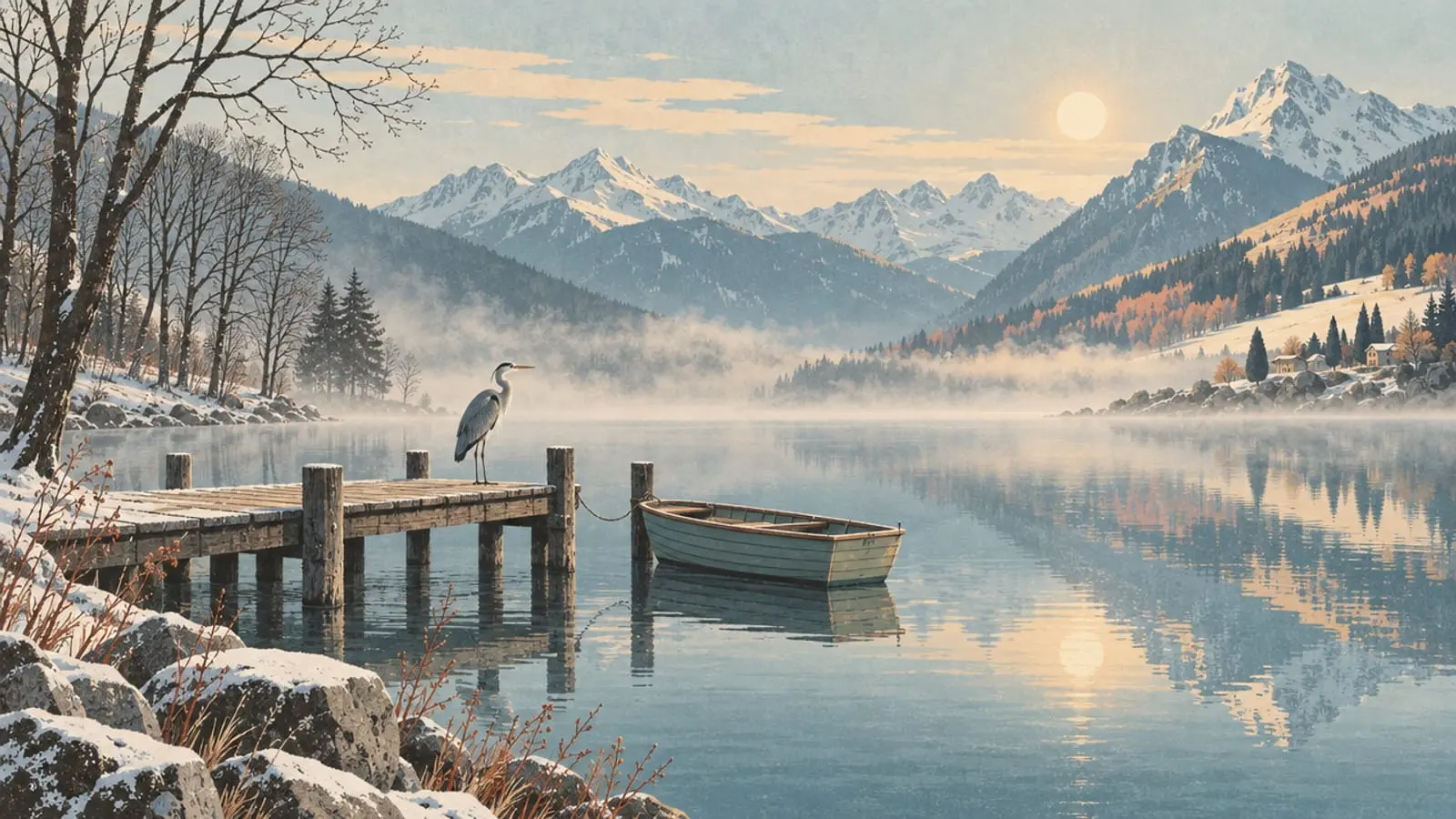
The same mechanism gives you, at water level, the best photographic hours of the year: mist lifting off the lake at first light, jetties floating in nothing, and the whole thing finished by ten.
What changes in the villages, honestly
The tourist season drives a large share of the lakeside economy. A good number of seasonal businesses on the western shore close for all or part of the winter, and boat traffic thins out sharply. That is not an atmospheric detail: it means you do not set off for lunch in Duingt in November without checking first, and you carry your own water on the greenway.
In exchange, the greenway goes back to being local space rather than a bike motorway, the water stays flat for want of wakes, and the morning reflections are perfect. The old town, for its part, returns to its original workings — the canals become legible again once there are no terrace tables in front of them, which is the subject of why the old town has canals.
The far end of the lake in winter: birds
At the southern end, the nature reserve at Doussard is the best place of the cold season. Reed beds, marsh, the mouth of the Eau Morte river: it is a wintering ground and a migration stopover, and the contrast with summer is total. In August it is the warmest bathing water on the lake. In January it is a hide.
Two pieces of advice that go together: come early, and come slowly. Wildlife shows itself to people who stop, not to people who walk fast. Stay on the marked paths — the reed bed is fragile, and it is precisely what you came to see.
March, April, May: the season that misleads most
Spring here is a calendar trap. In town the terrace tables are out and the air is mild. Three hundred metres higher the paths are mud; a thousand metres higher there is still snow, and the rain-snow line is legible with the naked eye on la Tournette, at 2,351 m.
April is when you see the most people set off in trainers for a high-altitude walk on the strength of the temperature at the water’s edge. The right use of spring is the lake at water level: the greenway has dried out, the villages are waking up, the light is lengthening, and nobody has arrived yet.
What we would not do
Come out of season counting on swimming, September excepted. Pick the western shore for a late-afternoon walk in January. Cancel a day because the town is grey, without checking whether the layer is an inversion. And plan a mountain pass in April because the Annecy forecast says 18 °C.
The lake does not go to sleep in winter. It simply changes its rules, and they are easier to learn than the August ones.
Our Annecy-specialised AI concierge knows those rules: out of season it writes days with no phantom swims and no closed passes, and an indoor plan B for every grey sky. Build my itinerary for free →
Sources
Read next
Things to do in Annecy →
Halloween in Annecy 2026: castles, spooky tales and family outings
Halloween 2026 around Annecy: Clermont castle in costume, tales at Montrottier, a free family ball, Criq’Parc, a castle fright night. Dates checked.

Annecy over the Christmas holidays 2026: market, snow, lake and castles
19 December 2026 to 4 January 2027: the Noël des Alpes market, the lights, snow 30 minutes away, the lake in winter. What is confirmed, and what is not yet.