An Annecy itinerary written for you, with no invented places
Our planner builds your Annecy trip from your answers, using only places actually found online — and nothing else.
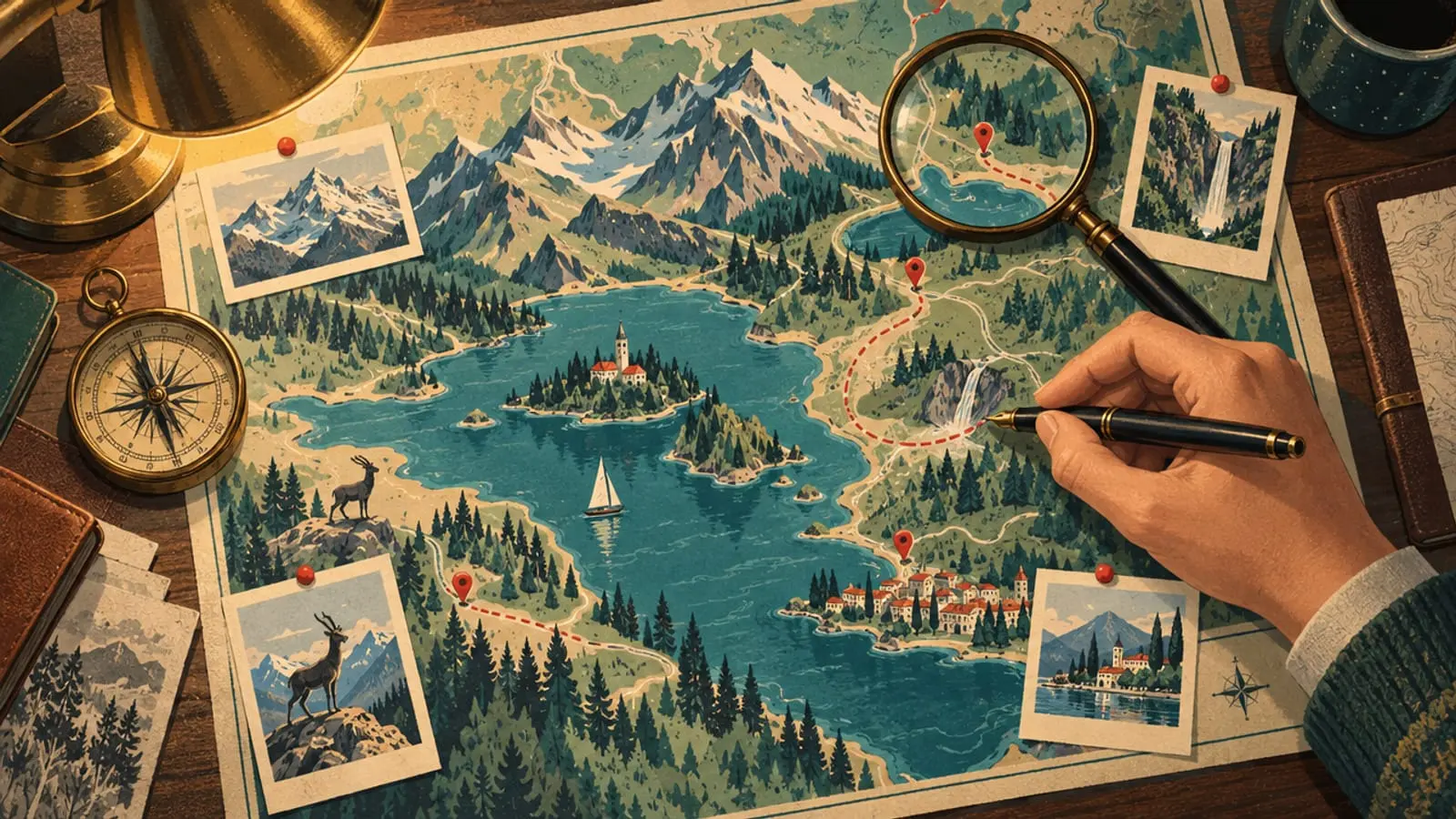
Ask any chatbot for a three-day plan in Annecy. You will get a beautifully phrased answer, with plausible opening hours and restaurant names that sound exactly right. Then you will look one of them up and find it closed in 2019. Or that it never existed at all.
That is the underlying flaw in these tools: they write what resembles a good answer. A credible Savoyard name, a plausible street, a believable opening time — all fabricated. On a real trip, the bill is paid standing in front of a shuttered door.
We built our planner on the opposite constraint.
The rule: no place that does not come from a real source
Before writing a single line of your itinerary, the tool runs a series of web searches shaped by your profile: morning cafés near where you are sleeping, walks suited to whoever is with you, evening tables, ice cream, markets. Only then does it compose your trip, using the places it actually found.
That constraint is enforced by the program, not by the model. Every step must point to a web address that came back in this round’s search results. A step whose source matches nothing loses its link; if the drift affects most of the itinerary, the whole thing is regenerated, and unverifiable steps are dropped rather than shown.
Put plainly: the model is not free to invent a restaurant, because it does not control that check.
An AI that knows the shape of the lake
The specialisation is not a coat of local varnish over a generic answer. It is what the tool knows about the lake’s geography, and what it infers from it.
You say where you are staying, and that changes everything downstream:
| You stay in | What the itinerary assumes |
|---|---|
| Annecy centre | Everything on foot, lively evenings, the market next door |
| East shore | Menthon, Talloires — quiet beaches, narrow summer roads |
| West shore | Sévrier, Saint-Jorioz — evening sun on the water |
| Far end of the lake | Doussard — nature first, a car often useful |
The remaining answers refine the route. A family with a pushchair is not sent up a steep path. A couple gets a dinner worth the detour. In high season the tool leans on whatever avoids driving: the lake shuttle, the greenway, walking. “The classics” and “off the beaten track” do not produce the same lake: the first embraces the château and the main beach, but at the hours when they are still breathable; the second points to the secondary shores and the valley villages.
Days that look like actual days
The tell-tale sign of an auto-generated plan is the three-block day: a sight, a lunch, another sight. Nobody travels like that.
Here each day covers the full span — the morning coffee or breakfast, the activity, lunch, the afternoon ice cream or market, dinner or the evening. Every step carries its time, its category, and one line of practical detail: the neighbourhood, how long to allow, which days it opens. The link to the source stays visible, so you can check before you go.
What the machine does not do
It books nothing. It does not know about the table that opened last week and that nobody has written about yet. It does not replace the tourist office for a shuttle timetable on a public holiday.
It keeps nothing either: your answers are used to compose the itinerary, then forgotten. No account, no history, nothing stored on our servers.
And when the result does not suit you, you say so — “less road cycling”, “what if it rains?”, “a table for a birthday” — and the relevant days are rewritten. Allow around twenty seconds for the first version: the time it takes to run the searches and sort through what comes back.
Where to start
Four questions: who you are travelling with, how long, in what spirit, and where you are sleeping. The rest is written from there.
And if you would rather have a plan edited by hand, our 48 hours in Annecy without the queues is still the best starting point for a first weekend.
Sources
Read next
Things to do in Annecy →
Halloween in Annecy 2026: castles, spooky tales and family outings
Halloween 2026 around Annecy: Clermont castle in costume, tales at Montrottier, a free family ball, Criq’Parc, a castle fright night. Dates checked.

Annecy over the Christmas holidays 2026: market, snow, lake and castles
19 December 2026 to 4 January 2027: the Noël des Alpes market, the lights, snow 30 minutes away, the lake in winter. What is confirmed, and what is not yet.