Savoyard food out of season: what you're actually eating
Fondue, raclette, tartiflette and berthoud: what these dishes really are, where the cheeses come from, and why menus change between July and January.
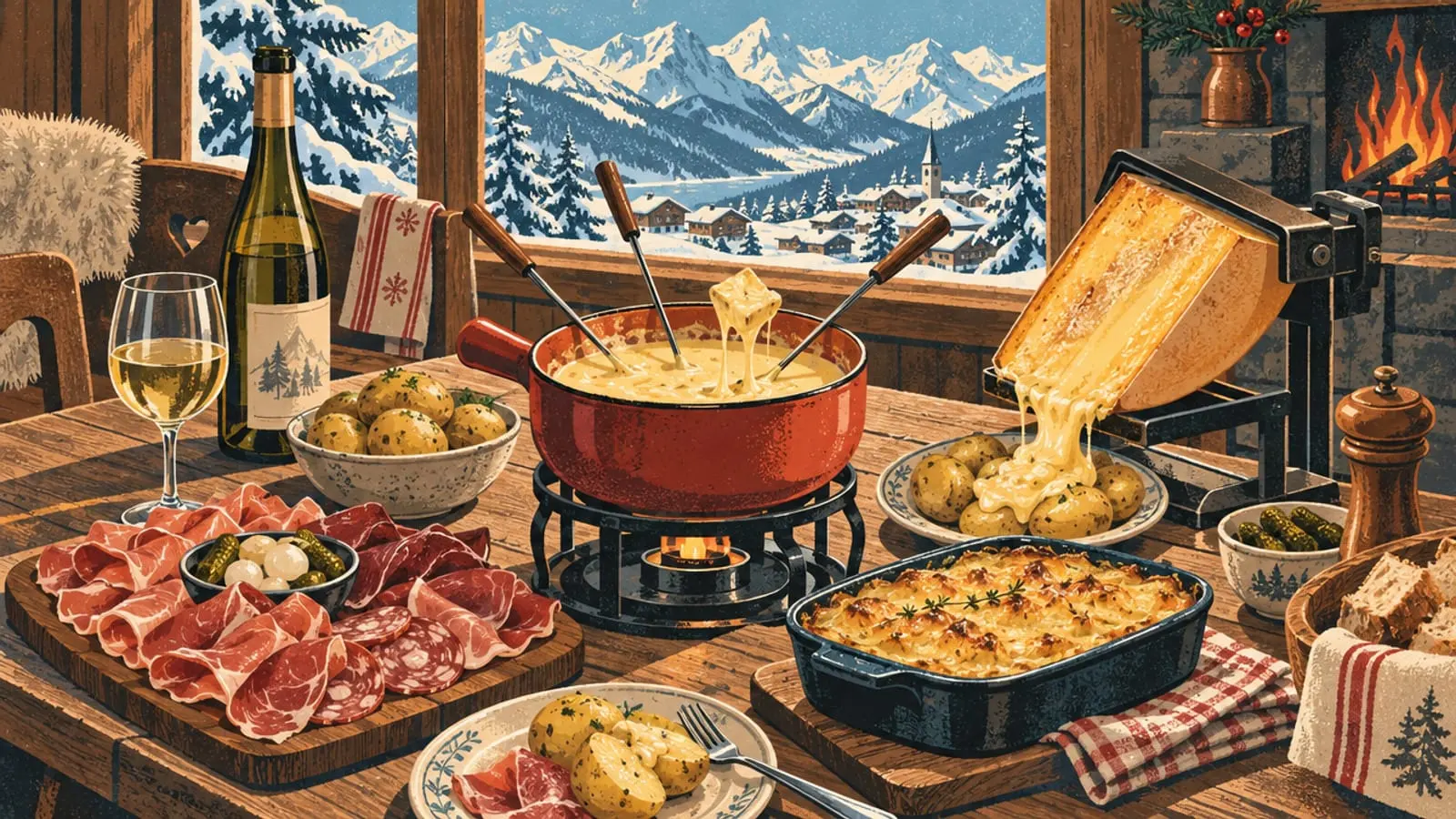
“Savoyard specialities” is a menu heading, not a family of dishes. Fondue, raclette, tartiflette and berthoud come from different places and different centuries, and two of them have nothing to do with Annecy. Knowing what they actually are isn’t about showing off. It’s about reading a menu without being told a story, in January as much as in July.
Four dishes, four different logics
Fondue has no protected recipe. No specification governs the dish itself: it is the cheeses that carry official marks, never the pot. The usual bases turn around Beaufort, Emmental de Savoie and Comté, in proportions that shift from one kitchen to the next. “Traditional recipe”, on a fondue, covers nothing you can verify.
Raclette works the same way round. The cheese called Raclette de Savoie has held a Protected Geographical Indication since 2017; the meal is governed by nothing at all. A PGI on the wheel says nothing about how it reaches your table.
Tartiflette is young. The word appears in the 1980s, pushed by the Reblochon trade body to widen the market for a cheese then eaten mostly within its own region; the recipe derives from the péla of the Aravis, a potato fry-up. Plenty of “traditional” dishes have a date of birth. That isn’t disqualifying — but age isn’t an argument here, and nobody should be selling it to you as one.
Berthoud is the only one of the four whose recipe itself carries a European protection: it has been a Traditional Speciality Guaranteed since 2020. It is a dish of the Chablais, in the north of the department — Abondance PDO melted in the oven in an individual dish, with white wine and garlic. In Annecy it is perfectly legitimate, but it comes from another valley. Saying so costs nothing.
What the labels actually guarantee
A PDO (AOP in French) requires everything to happen inside the defined area: milk production, cheesemaking, ageing. A PGI (IGP) rests on know-how and a looser geographical link covering one stage. Both are serious. They do not promise the same thing.
| Cheese | Mark | What the specification says |
|---|---|---|
| Reblochon | PDO | Raw milk, three cattle breeds (Abondance, Montbéliarde, Tarine), the mountains of Haute-Savoie and the Val d’Arly; 18 days’ ageing minimum |
| Abondance | PDO | Pressed, semi-cooked paste, 176 communes of Haute-Savoie, 100 days in the cellar minimum |
| Beaufort | PDO | Beaufortain, Tarentaise, Maurienne and part of the Val d’Arly — that is, Savoie, not Haute-Savoie |
| Raclette de Savoie | PGI | Recognised in 2017, raw milk, local breeds |
Remember one detail above all: a green casein plate marks a farmhouse reblochon, a red one a dairy reblochon. It is the only physical marker in the whole list, and it sits on the cheese itself. The farmhouse version is made on the farm, twice a day, with milk from the milking that has just finished; the dairy version is collected and transformed in a workshop. Neither is a fault. But staff who don’t know which one they are serving don’t know much else either.
Summer makes it, winter eats it
This is the part no menu prints, and it inverts the visitor’s instinct.
Beaufort chalet d’alpage is made only during the “hundred days”, June to October, above 1,500 metres, twice a day, from the warm milk of a single herd. Beaufort d’été, produced during that same season on the high pastures, is eaten in winter, after five months of ageing. Abondance needs at least 100 days in the cellar before it leaves.
Put plainly: the cheese you eat in July was made the previous winter, and the alpage cheese behind the cows you photograph on the ridges in August will reach a plate around Christmas. Production season and eating season are half a year apart. So a “seasonal” Savoyard cheese menu doesn’t exist the way it does for a vegetable — but ageing does, and you can taste it.
Why the menu changes between July and January
It isn’t the cheese that runs short in summer, it’s the appetite. A shared pot at 28 °C on a quayside is an act of endurance.
So why does fondue stay on the board in August? Because it gets asked for, and because it has operational qualities few dishes offer: prepared in advance, no à la minute cooking, finished in the dining room, stable product. A place running on throughput has no reason to take it off.
The useful signal, then, isn’t whether fondue is on the menu in summer. It’s what sits next to it. A kitchen that lives with the season offers something other than melted cheese in July: market vegetables, fish, a cold starter that isn’t a charcuterie board. If the four Savoyard dishes fill half the menu in high summer, the house isn’t cooking the season, it’s selling a backdrop — the same reasoning as the six tells for reading a terrace.
The reverse holds in January: a menu that tightens around three hot dishes is usually a good sign.
Three questions that sort a menu in thirty seconds
- Is the reblochon farmhouse or dairy? The answer exists, printed on the plate.
- Which cheeses go into the fondue? A kitchen that cooks names three without pausing.
- Where does the Abondance come from? “From the region” means nothing: the area runs to 176 communes.
What we wouldn’t do
- Order fondue on the first evening of a short August stay. Over two days — see the 48-hour itinerary — it costs you an evening and a morning.
- Treat tartiflette as a medieval inheritance. It is a very good dish from 1980.
- Hunt for berthoud as an Annecy speciality. It belongs to the Chablais, and owning that beats dressing it up.
- Take the word “traditional” as a guarantee. The only written guarantees here are called PDO, PGI and TSG.
The cheese calendar isn’t the traveller’s calendar: the high pasture works in August and is eaten in February. No menu writes it down, and it is the only seasonality that really counts.
Sources
Read next
Where to eat in Annecy →
Lake fish in Annecy: four species, many misunderstandings
Féra, Arctic char, perch and pike: what the lake actually produces, who fishes it, and how to spot a menu that promises lake fish without serving it.
Lakeside terraces: six tells before you sit down
How to tell, on Annecy's quaysides, a terrace that actually cooks from one that only sells its view. Six reliable signals.